Thursday, September 9, 2010
The Real 'New Year'
I can understand why January 1st was chosen to mark the beginning of a new year... it must have had something to do with the tilt of the earth, and days becoming noticeably longer by January 1st after the nadir of the winter solstice. It could be that on this December 31st, as I sit with friends and family and we reminisce and make resolutions for the coming year, I may feel differently than I do now.
However, at this point, the beginning of September seems a far more realistic 'New Year' than a cold, dark, rainy January day.
Most of my life has been spent gearing up for a new session in September, either as a kindergartener, high schooler, university student, or professor. The rhythm of the year naturally tends towards relaxing as far as can be done in August so that one can be as fresh as possible for the all important first few weeks in a term.
The day after Labour Day is a time of rejuvenation: people at work are inspired, full of energy, and hopeful for the future: there is nothing quite like the feeling of the first few weeks at a college.
Also, the kids have begun school and their various after school activities. A new season of soccer for Aidan is in full swing, and Kira's karate begins next week.
Last, but certainly not least, my favourite TV shows begin their new seasons soon, including NFL on Sundays, House, 30 Rock, and Glee.
Wednesday, August 11, 2010
Relative Expectations
Our tent camp (shot and stitched by Trent Rouse)
Our dig spanned the last 2/3 of the World Cup of Soccer in South Africa, and it is probably this tournament more than anything that set into relief our lowered expectations.
I had managed to watch a few games at home before we left, but the very fact that we could not easily watch these games in Jordan gave them much more added importance. We managed to watch five games. Luckily, our first weekend break in Aqaba was spent during the group of 16 stage of the tournament, and so we were able to watch three games, including England/Germany, US/Ghana, and one other I cannot remember. After this, I contacted Hussein, the Manager of the Eco Lodge where we stayed last summer, and although we had nothing to do with the Eco Lodge this year, he invited us to the Reception centre in a nearby village so that we could see Holland play Brazil in a cracker of a game. We also were able to listen to two games on my shortwave radio in camp. Finally, we arranged our last weekend so that we could watch the final in our hotel rooms in Aqaba.
Justa, our lone Holland representative, singing the Dutch anthem
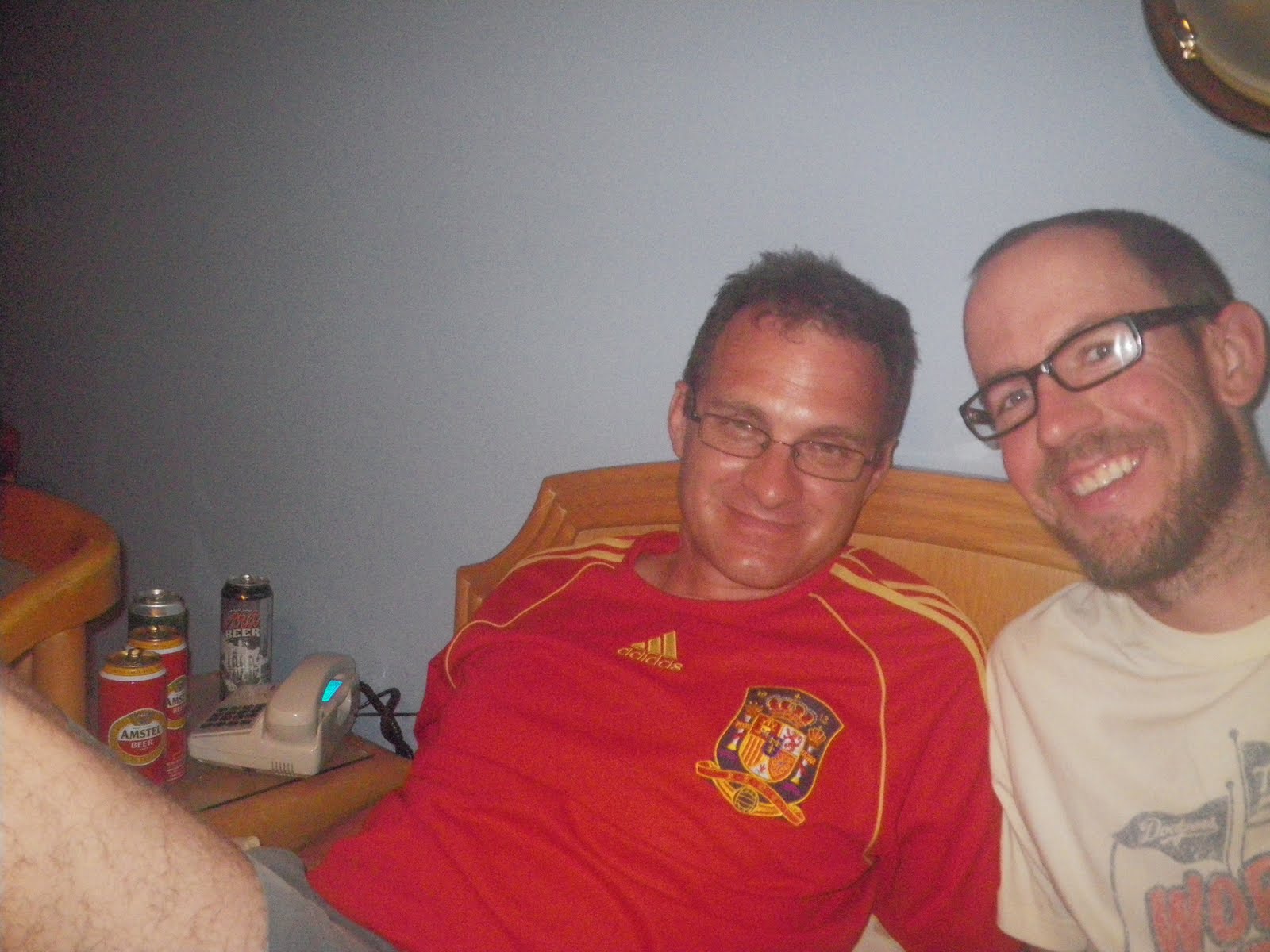
Trent and I watching the final (Justa hated my Spanish jersey)
The World Cup experience of 2010 was particularly wonderful because our expectations were low.
Summer, 2010
We have just returned from our summer holidays. Kira and I were in Jordan for 30 days, and met Denise and Aidan at the airport in Cairo. We stayed for 12 days in Egypt, and on our way back home, stopped over in Germany for 6 days. We stayed with relatives in Hagen, in North-west Germany.
The following posts reflect some of the insights of this wonderful summer sojourn.
Tuesday, June 8, 2010
The Road
It has been a while since I have sat down to write a post to this blog. I have been madly trying to get things ready for our dig in Jordan, less than two weeks away, as well as prepare 10 students adequately for what is about to come.
The other night the kids and I sat down to watch 'The Road'. This is a film adaptation of a book by the same name by Cormac McCarthy that came out a couple of years ago. I really liked the book, and thought I would like the movie as well. However, while the stark, dire, grey, punishing post-apocalyptic world of the book was somehow bearable, after two hours of watching the film adaptation, I had had enough. In fact, it took some time to process what I had seen. While the movie making was marvelous, I'll neither watch the film again, nor will I recommend it to anyone else. I am not convinced that we must necessarily experience something so starkly different in order to appreciate all we have in our own reality.
Friday, May 14, 2010
Motorcycles and Castles
This morning over breakfast, Denise and I talked about why it is that we like castles. Our conversation meandered here and there and included a discussion of Pirsig's 'classical' and 'romantic'. 1974, Robert Pirsig wrote Zen and the Art of Motorcycle Maintenance, and in it he describes a motorcycle journey across the US. Throughout the book, he enters into deep philosophical discussions, and relies often on two very different concepts: the 'classical' and the 'romantic' ways of looking at things.
He first uses these concepts in a description of riding his motorcycle. In the classical realm, his motorcycle moves forward according to Newton's laws of motion. Fossil fuels are ignited by a spark that fires cylinders that drive cams that turn a chain that compels the back wheel to spin. An alternator collects energy from the motion and charges a battery that provides energy to create a spark, as well as run a headlight and honk a horn. The rider turns directions by changing the trajectory of the front wheel with the handle-bars, increases speed by compressing the accelerator that then provides more fuel to the engine, and stops by engaging a front and rear brake. And on and on.
In the romantic realm, the process of riding a motorcycle can evoke in the rider a feeling euphoria: the rider has 360 degrees of vision, can accelerate and slow down easily and quickly, can smell the flax in the fields, feel the heat of the sun on one's skin, the pull of gravity ascending a hill, and the bumps along the highway. The rider feels liberated and powerful.
As for castles, from a classical standpoint, they were designed to keep people out. If the defenders could keep a besieging army outside a castle's walls for a year, eventually the besiegers would give up and go home. However, if the defenders could breach the walls and the inner keep, the castle had failed its primary purpose, and the inhabitants inevitably would meet a nasty end. The eventual use of gunpowder rendered castles useless at keeping people out, and nobles stopped building them. Today, the castles of Europe are either in ruin or rebuilt and inhabited by wealthy people like J.K. Rowling: however, they are no longer used to keep out attacking armies.
The Keep at Warkworth castle, Northumberland
Warkworth's floor plan
(1: vestibule; 2: hall; 3: chapel; 4: great chamber; 5: kitchens; 6: pantry and buttery)
While the architecture of this castle is intriguing, this castle is far more interesting from a romantic standpoint. Perhaps a castle somehow reminds us of what it was like to live in a womb where we were protected, safe, happy, and warm. Looking through the windows of Warkworth's keep at rolling, green hills and the frigid North Sea beyond, one feels completely safe. But there is more to it than security. Because castles sometimes were besieged for a year at a time, they had to be 'liveable' or people would have been driven to the depths of depression. While big, strong thick walls were necessary, a castle also needed 'light'. Rather than cookie cutter floor plans, architects designed each floor on a different plan of very different characters, connected to each other by a grand staircase and also 'hidden' staircases. One such hidden staircase is in the back of the kitchen fireplace, another in a 'garder-robe' (toilet). Castle architects needed to be creative and imaginative, using the resources and topography available to them. The castles of those long dead people were interesting then, and continue to be interesting today.(1: vestibule; 2: hall; 3: chapel; 4: great chamber; 5: kitchens; 6: pantry and buttery)
And there is one more thing. As a kid I and my friends and siblings made all sorts of different forts. Over those long prairie winters I would sometimes collect all sorts of stuff around the house and make grand forts in the living room. Sometimes if there was enough snow, we would tunnel down into the snow-banks and make forts. I even remember the occasional attempt at an igloo. In the summers, we would head off into the woods and make tree forts. There seems to be something in us that compelled us as kids to make forts. It could be that by doing so, we satisfy a need to nest. Who knows. Whatever it is, I have had the same feeling inside Warkworth's keep that I did inside a fort made of pillows and bed-sheets in my boyhood living room.
Indeed, castles evoke in me something that goes far beyond glacis, moats, baileys, and all the other cool aspects of castle architecture. While castles are very intriguing classically, they are far more interesting from a romantic point of view.
Wednesday, May 12, 2010
Technology's heady pace
Lately I have been preparing for the dig in Jordan this summer. Well into Spring session, I lead a seminar on Monday mornings in which I and 10 students (and Kira) discuss things Jordanian and archaeological. I am also making necessary purchases and trying out new software and hardware. What strikes me most is the difference in data collection software and hardware over the last few years.
In 1998 I purchased a TDS data collector for the Total Station survey instrument used in archeological survey and excavation. I used it in 1998, 1999, 2000, twice in 2002, twice in 2003, and finally in 2004. Last year for our survey in Jordan I purchased an 'Archer' data collector with Microsurvey's 'Field Genius' survey software. Even though just 11 years had passed, the difference in technology between the Archer (and software) and TDS is astounding.
The TDS collected five fields of data: point number, northing, easting, elevation, and three letter descriptor for the point. That was it. All of the spatial and artifact points were collected as discrete, individual points. That meant that hours upon hours of manipulation of the data was necessary at the end of each day in order to get it ready for GIS (Geographic Information Systems). All of the spatial points needed to be connected into 'shapes', and all of the artifacts needed to be tagged in a spreadsheet with additional information. All of this was done by students who had spent the day in the hot sun, and mistakes were inevitable.
In contrast, the Archer sits on a Windows CE platform, and so all of the wonderful Windows applications become available. The data collection allows one to customize the menus in two broad categories. The first is the collection of artifacts. For example, a menu might allow the user who has chosen 'ceramics' to fill out a number of screens that correspond to the fields used later in analysis. The user might be asked if the sherd is 'diagnostic', and if so, whether it is a rim, base, handle, lug, or perhaps if it is incised, painted, glazed, coloured, and on and on. The same sorts of menus can be designed for lithics (stone), metals, faunal (animal bones), shells, human bones, coral, jewelry, teeth, etc. The user at the Total Station will simply input this data upon collection rather than passing it along down the data stream to a brain-dead student wishing he or she was somewhere else doing anything other than inputting data into a spread-sheet.
The other set of menus allows the user to collect 'space'. Modern archaeology is based on the concept of discrete three dimensional spaces in which artifacts are set in a matrix. It is important to at least collect the perimeters of the surface and bottom. The Archer and software allows one to collect a point in space that is then visible on the screen. When the next point is taken, a line is drawn between the two. When the rim of a pit, for example, is defined by perhaps 10 points, the user then 'closes' the 'polygon'. This perimeter is now a discrete unit, rather than a series of points that need to be connected later. Again, menus will prompt the user for the context number, whether this is a surface or bottom perimeter, and what kind of 'space' it is, such as a pit.
When the day's work is done, two files will be exported. One will be an artifact 'shape' file, the other a spatial 'shape' file. These files are then imported directly into GIS.
This year's data collector goes beyond the Archer. The Nautiz not only collects artifact and spatial data in the same way, but it allows one to take a picture of the artifact. The picture is then linked to the artifact by its point number, and both are then easily exported to GIS. The Nautiz not only has Bluetooth, but also LAN (WiFi) capability, and so one simply connects back and forth from a laptop via a router. To top it off, the Nautiz has a built-in GPS receiver.
The next generation of data collectors must surely fry eggs, or perhaps shovel snow in December.
In 1998 I purchased a TDS data collector for the Total Station survey instrument used in archeological survey and excavation. I used it in 1998, 1999, 2000, twice in 2002, twice in 2003, and finally in 2004. Last year for our survey in Jordan I purchased an 'Archer' data collector with Microsurvey's 'Field Genius' survey software. Even though just 11 years had passed, the difference in technology between the Archer (and software) and TDS is astounding.
The TDS collected five fields of data: point number, northing, easting, elevation, and three letter descriptor for the point. That was it. All of the spatial and artifact points were collected as discrete, individual points. That meant that hours upon hours of manipulation of the data was necessary at the end of each day in order to get it ready for GIS (Geographic Information Systems). All of the spatial points needed to be connected into 'shapes', and all of the artifacts needed to be tagged in a spreadsheet with additional information. All of this was done by students who had spent the day in the hot sun, and mistakes were inevitable.
In contrast, the Archer sits on a Windows CE platform, and so all of the wonderful Windows applications become available. The data collection allows one to customize the menus in two broad categories. The first is the collection of artifacts. For example, a menu might allow the user who has chosen 'ceramics' to fill out a number of screens that correspond to the fields used later in analysis. The user might be asked if the sherd is 'diagnostic', and if so, whether it is a rim, base, handle, lug, or perhaps if it is incised, painted, glazed, coloured, and on and on. The same sorts of menus can be designed for lithics (stone), metals, faunal (animal bones), shells, human bones, coral, jewelry, teeth, etc. The user at the Total Station will simply input this data upon collection rather than passing it along down the data stream to a brain-dead student wishing he or she was somewhere else doing anything other than inputting data into a spread-sheet.
The other set of menus allows the user to collect 'space'. Modern archaeology is based on the concept of discrete three dimensional spaces in which artifacts are set in a matrix. It is important to at least collect the perimeters of the surface and bottom. The Archer and software allows one to collect a point in space that is then visible on the screen. When the next point is taken, a line is drawn between the two. When the rim of a pit, for example, is defined by perhaps 10 points, the user then 'closes' the 'polygon'. This perimeter is now a discrete unit, rather than a series of points that need to be connected later. Again, menus will prompt the user for the context number, whether this is a surface or bottom perimeter, and what kind of 'space' it is, such as a pit.
When the day's work is done, two files will be exported. One will be an artifact 'shape' file, the other a spatial 'shape' file. These files are then imported directly into GIS.
Nautiz X-7
The next generation of data collectors must surely fry eggs, or perhaps shovel snow in December.
The Canucks broke my heart
Canucks trying to deal with Chicago's forwards
Predictably, the gifted, brilliant, mercurial Canucks went down in defeat in the sixth game of the second round of the Stanley Cup play-offs last evening. In fact, they lost the game and the series on the same day exactly one year after they lost in six games to the same Chicago Black Hawks in the second round of last year's play-offs.
For those of you out there who care even a little bit, the following lists excuses for why the Canucks lost yet again.
1. The Stanley Cup play-offs are a war of attrition, and the Canucks were beaten up. Most teams play 7 defencemen in the play-offs, and the Canucks were down to three active defencemen last night, one of whom two days before suffered what many believed to be a 'ruptured testicle' after he blocked a shot in front of his net. Yikes. Injured Canuck defencemen include Sami Salo, Alex Edler, Willie Mitchell, Aaron Rome, and Nolan Baumgartner.
2. Roberto Luongo is sometimes a brilliant goalie, and other times very ordinary. In three of the four losses against Chicago, my son Aidan might have stopped more shots than Luongo, and Aidan is a soccer player.
3. Chicago is filled with skilled players who build from the back and come across the blue line in waves. This is an extraordinarily talented hockey team. Many times in this series I sat back and simply marveled at the skill of the Black Hawks. They are a wonder to watch.
4. Chicago is better coached. Joel Quenville knew that the Canucks were hurting on defence, and made sure that his big forwards like Byfuglien (pronounced 'Buff-lin') hit the Canuck's defencemen every chance they got. When Shane O'Brien got cut by a stick across his forward, and then had it glued and stitched so that he could return, a Chicago player sought out O'Brien and punched him right in the stitches. This is simply smart hockey.
5. Next year the Canucks will celebrate 40 years in the NHL, with only two Stanley Cup finals appearances to show for it. Like the Boston Red Sox, the Canucks are cursed. Won't someone please slaughter a goat?
Subscribe to:
Posts (Atom)