Monday, October 25, 2010

An evening with Stuart McLean

A Master Story-teller

Last evening's concert ranks as one of my favourites.  Denise and I saw Stuart McLean and his accompanying musicians at the Tidemark in Campbell River.  Because I have wanted to see him in person for so long, I made sure to get to the ticket counter when it opened, many months ago: Denise and I sat front row centre.

Stuart was taping a show to be aired on CBC's The Vinyl Cafe on the last Sunday in November.  Behind the stage was an enormous map of Canada, and on it were push-pins and names of the places he had been on this tour.  He seems to have started on the eastern sea-board, and has made his way across Canada, visiting little towns like 'Iqaliut' in the North-west territories, 'Drumheller' in Alberta, and 'Smithers' in BC. 

Stuart McLean, if you do not know of him, is a master story-teller.  We were lucky to hear two new stories last evening, stories that involve, as all his stories do, a fictional family living in southern Ontario.  Stuart weaves into his stories a combination of humour and humanity. His characters are flawed, sometimes impossibly funny, and often very, very sweet. I listen to Stuart on those wonderful Sunday's when I have found time to mow the lawn, weed the garden, work in my shop, and focus as Stuart takes me by the hand to another place.  Sometimes I have to sit down and simply give myself over to a fit of laughing, trying to catch my breath, as Stuart tickles me relentlessly. Other times, I need to brush away a tear before anyone around me notices.  Stuart can do that to me inside of a few minutes: I'll be laughing uproariously, and then find that I need to focus intently on something on my work bench.  I think the power of his stories lies in this particular recipe.

I think that we are set up as a species to enjoy hearing someone tell us stories.  When my children were little, we seemed to spend hours everyday reading stories.  In fact, they would prefer having a story read to them over just about anything else.  They wanted to cuddle up, one under each arm, listen to my voice, and look at the pictures as we all embarked on an adventure.  For some reason, they seemed to prefer books that we had read over new books.  Sometimes Kira would comb the hair of a doll as she listened, grooming her baby, seemingly unaware of the generational link between father, daughter, and dolly. 


In some way, and although difficult to prove, we might be genetically hard-wired to listen to stories as a way of learning our primary languages.  Our babies want to listen to stories perhaps as a way to continue the seemingly impossible task of learning a language from scratch within a couple of years. However, the joy of listening to stories stays with us beyond childhood.  We spent a couple of million years as food foragers sitting around camp-fires at night, presumably listening to people tell stories.  Socially, such events may have been a 'social glue', bonding together ever more strongly the group.  It could be that those individuals who did not care for taking part in such social exercises, and tended rather to go off on their own, fell out of the gene pool from which we are all descended.  Also, such stories helped to explain mysteries, such as why things were the way the were, where things came from, what it is all about. And so, story-telling may have allowed us to learn language, bring our group of people closer together and therefore give it more survival power, and explain those things otherwise unexplainable.  In short, it might not be too far a stretch to say that we are human because we like to hear stories.   

Stuart McLean is light-hearted, funny, and he seems to have a knack for discovering the quirkiness and generosity of the human spirit. In a way he steps out of time.  He might indulge in a modern colloquialism, but when he does, it is to make some sort of point.  He appealed to the 89 year old in our audience, as well as to the youngest, a five year old girl named Ella, and everyone in between.  His skill in developing pace, tension and a really good joke builds a trust between him and his audience that his plot lines will resolve, that irrelevancies will be minimized, and that there is an overarching theme to his stories.  He allows the people in his audience to simply sit back, relax, and let the master weave his wonderful story.  Although telling his stories in 2010, one can imagine him telling similar stories to a group of kinsmen sitting around the fire in 2,000,000 BC.

A Pro Forma World


Stuart McLean

I have been noticing lately that our society is increasingly treating certain things as mere formality.  The obvious example of this is tipping a waiter at a restaurant.  It seems that we are expected to tip at least 15%, regardless of the service.  A friend of mine who happens to be a waiter has told me that getting 'stiffed' by a customer (not getting tipped), is a huge financial blow.  Not only are the base per hourly wages very low, but the person who has not tipped has taken the time away from a customer who would have tipped.  This means that in order to show that we are very pleased with the service, we need to tip in excess of 15%.  In real terms, what it means for me is that when paying the bill, I simply hit the '15%' button for the tip, the calculator works it out, and I sign on the dotted line.  Gone, it seems, is the reward system for exceptionally good service.  It has all become institutionalized. 

Last evening, Denise and I went to see Stuart McLean (more on him in the next post) in concert at the Tidemark theatre in Campbell River.  Stuart (I call him by his first name, because he feels like a family member) has an easy way about him, and entertained us with various stories, and his accompanying musicians played wonderful blues music throughout the evening.  Granted, his performance was different than other performances in that it was a CBC radio broadcast to be aired on the last Sunday of November, but nevertheless, Stuart did something that I have not seen in a very long time: he did not do an encore.  Instead, he thanked the audience for our support, he had his supporting musicians take a bow, and thanked all of the people working behind the scenes to make it work.  Then, after Stuart had the musicians and the audience sing a few choruses of 'You are my sunshine', he gracefully left the stage, the house lights came on, and we all left.

Many in the audience, it seemed, wanted, or at least expected more, and they stood and clapped, even though the house lights were on and people were moving out of the exits.  One could almost hear them saying: "Really, Stuart, this is not how it is done.  You leave, we stand and clap, you come out for some more, then leave, we stand and clap, you come out for one last kick at the can, then leave again, and then we clap... at that point and not one second sooner, the house lights come on." 

However, Stuart is unwilling to go through the pro forma, perfunctory and silly formalities that have accreted to the edges of modern entertainment.  The last thing he said to us before he left the stage was: 'Go home to your families.'  Good for you, Stuart.

Thursday, September 30, 2010

Food Foragers and Institutionalized Religion

!Kung bushmen of the Kalahari

Today's lecture in cultural anthropology covered the characteristics of the food forager way of life.  Our ancestors carried on this way of life for at least 2 million  years before we began, a mere 10,000 years ago, producing food.  Midway through the lecture I was struck by something out of the blue. 

Before the momentous switch in subsistence, food foragers lived as those who still exist live now.  Today's food foragers live in small groups, cooperate with each other, share all their food, are egalitarian, have little to no personal possessions, are nomadic, and pursue for most of everyday what we would call leisure activities, including story telling, dancing, and singing. 

Sometime after the beginning of food production, when our populations became more sedentary and started to rise dramatically, we began to 'institutionalize' all sorts of things like politics and religion and markets. The thought bubbling under the surface today was that there are many many similarities between the food foraging way of life and the kind of life prescribed by many institutionalized religions today.

For example, it seems that institutionalized religions are intent on bringing adherents together into communities, many of which are at a small scale (a parish, for example), and the people of these communities are encouraged to cooperate with each other, and help each other out when and where possible.  Such religions also preach an equality of people under a god/s, or goddess/es, and some of them profess the importance of not getting too attached to material objects.  Such religions also have rituals that include story-telling, dancing, and singing. 

It seems that, at least in some ways, institutionalized religions attempt to bring us back as much as possible to the lives we spent as food foragers for over two million years.

And taking this a step further, I wonder about Judeo-Christianity's Creation Myth set in the Garden of Eden.  Adam and Eve are happy gatherers until the fruit is eaten, at which point they are banished to a life of tilling the soil and raising livestock, or in other words, food producing.  Perhaps within these pages we see the 'paradise' of food foraging, and the punishment of food production, and perhaps a religion's goal to bring people somehow back to a not completely forgotten paradise of the food foraging way of life. 

Thursday, September 9, 2010

The Real 'New Year'


I can understand why January 1st was chosen to mark the beginning of a new year... it must have had something to do with the tilt of the earth, and days becoming noticeably longer by January 1st after the nadir of the winter solstice.  It could be that on this December 31st, as I sit with friends and family and we reminisce and make resolutions for the coming year, I may feel differently than I do now.

However, at this point, the beginning of September seems a far more realistic 'New Year' than a cold, dark, rainy January day.

Most of my life has been spent gearing up for a new session in September, either as a kindergartener, high schooler, university student, or professor.  The rhythm of the year naturally tends towards relaxing as far as can be done in August so that one can be as fresh as possible for the all important first few weeks in a term.

The day after Labour Day is a time of rejuvenation: people at work are inspired, full of energy, and hopeful for the future: there is nothing quite like the feeling of the first few weeks at a college.

Also, the kids have begun school and their various after school activities. A new season of soccer for Aidan is in full swing, and Kira's karate begins next week. 

Last, but certainly not least, my favourite TV shows begin their new seasons soon, including NFL on Sundays, House, 30 Rock, and Glee.

Wednesday, August 11, 2010

Relative Expectations

Our tent camp (shot and stitched by Trent Rouse)

One of the themes of the Jordan dig of 2010 was that our appreciation of things tends to increase with a similar decrease in expectations.  We all stayed in tents that we brought from Canada, so that the beds in the hotel rooms on the weekends were all the more comfortable.  Although our cook, Aladdin did an amazing job preparting our meals, nevertheless, the Movenpick ice cream on weekends was particularly wonderful.  If the beer on the dig was sometimes warm (or even frozen solid), somehow even warm beer can taste good if it is the only beer available. 

Our dig spanned the last 2/3 of the World Cup of Soccer in South Africa, and it is probably this tournament more than anything that set into relief our lowered expectations.

I had managed to watch a few games at home before we left, but the very fact that we could not easily watch these games in Jordan gave them much more added importance.  We managed to watch five games.  Luckily, our first weekend break in Aqaba was spent during the group of 16 stage of the tournament, and so we were able to watch three games, including England/Germany, US/Ghana, and one other I cannot remember.  After this, I contacted Hussein, the Manager of the Eco Lodge where we stayed last summer, and although we had nothing to do with the Eco Lodge this year, he invited us to the Reception centre in a nearby village so that we could see Holland play Brazil in a cracker of a game.  We also were able to listen to two games on my shortwave radio in camp.  Finally, we arranged our last weekend so that we could watch the final in our hotel rooms in Aqaba. 

Justa, our lone Holland representative, singing the Dutch anthem

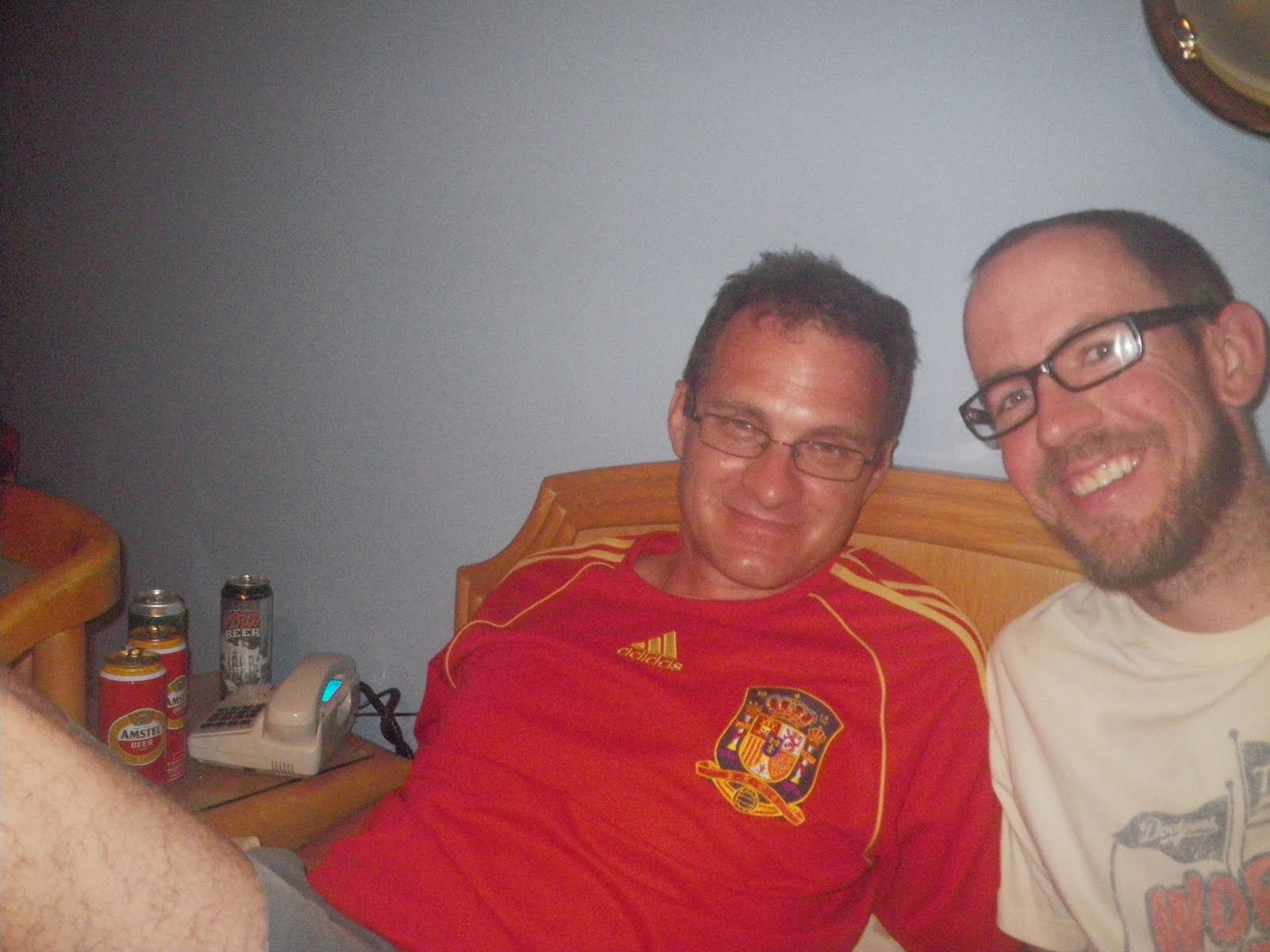
The game took on a festival atmosphere.  We all piled into Trent and Lynne's room, and Justa painted faces in her native Holland colours.  Most people there did not seem so interested in the game, but there were enough hard core soccer fans to keep the focus on the game.  Spain won in extra time in a thrilling finish. 


Trent and I watching the final (Justa hated my Spanish jersey)


The World Cup experience of 2010 was particularly wonderful because our expectations were low. 

Summer, 2010

We have just returned from our summer holidays.  Kira and I were in Jordan for 30 days, and met Denise and Aidan at the airport in Cairo.  We stayed for 12 days in Egypt, and on our way back home, stopped over in Germany for 6 days.  We stayed with relatives in Hagen, in North-west Germany.

The following posts reflect some of the insights of this wonderful summer sojourn. 

Tuesday, June 8, 2010

The Road


It has been a while since I have sat down to write a post to this blog.  I have been madly trying to get things ready for our dig in Jordan, less than two weeks away, as well as prepare 10 students adequately for what is about to come. 

The other night the kids and I sat down to watch 'The Road'.  This is a film adaptation of a book by the same name by Cormac McCarthy that came out a couple of years ago.  I really liked the book, and thought I would like the movie as well.  However, while the stark, dire, grey, punishing post-apocalyptic world of the book was somehow bearable, after two hours of watching the film adaptation, I had had enough.  In fact, it took some time to process what I had seen.  While the movie making was marvelous, I'll neither watch the film again, nor will I recommend it to anyone else.  I am not convinced that we must necessarily experience something so starkly different in order to appreciate all we have in our own reality.